
Paying the Power Bill in a Thin Month Without Dumping Coins
The electricity invoice arrives on a fixed date and the coins arrive hourly, but the dollars behind them do not. In a month when the price sags, a miner at 356 TH/s still books 12.98 USD a day net of the listed fee — 389.40 over thirty days — against a bill that may not have moved at all. Borrowing against the coins instead of selling them is one way to close that gap, provided the repayment plan is built before the gap appears.

Key takeaways
- At 356 TH/s the net figure is 12.98 USD a day, or 389.40 across a thirty-day month.
- Selling coins to pay a bill converts a temporary shortfall into a permanent reduction in holdings.
- A Collateral-Pledged Loans position keeps the coins pledged rather than sold, so the upside stays on your side of the ledger.
- Size the draw to one invoice cycle plus a buffer, not to the whole year's costs.
Two cycles that never quite meet
Mining revenue is continuous and the power bill is periodic. That mismatch is harmless while the price is steady and becomes sharp when it falls, because the bill is denominated in dollars and the revenue is denominated in a coin whose dollar value can move ten percent in a fortnight. A miner who plans only in coins will feel nothing. A miner who plans in dollars will see the squeeze coming about three weeks early.
The usual reflex is to sell. Selling is simple and it has a real cost: the coins leave, and if the price recovers next quarter the miner has paid the bill with the most expensive asset in the business. A secured position such as ViaBTC Crypto Loan keeps the coins in place and turns the shortfall into a dated obligation. That is not a free trade — there is interest and there is a collateral threshold — but it is a trade worth pricing rather than reflexively avoiding.
Three hashrates, gross and net, on one page
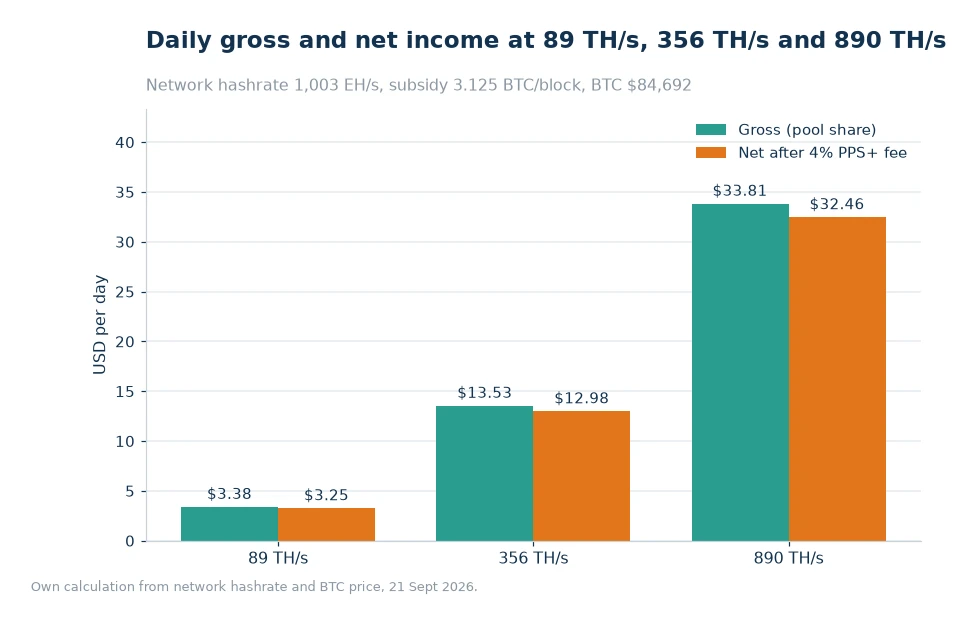
The table sets out what each tier produces before and after the listed 4% on the block-reward component. The gap column is the fee in dollars, which is worth seeing explicitly because it is easy to mistake the gross figure for take-home.
| Hashrate | Gross per day | Net per day | Fee retained per day |
|---|---|---|---|
| 89 TH/s | $3.38 | $3.25 | $0.13 |
| 356 TH/s | $13.53 | $12.98 | $0.55 |
| 890 TH/s | $33.81 | $32.46 | $1.35 |
The fee column scales with the machine, which is why a small operator sometimes assumes the fee is negligible. At 890 TH/s it is 40.50 USD a month, roughly a tenth of a typical residential power bill. It is not the reason a month goes wrong, but it is part of the reason the net figure is the one to put against a cost.
Sizing a Collateral-Pledged Loans position around a bill
Start from the shortfall, not from the maximum the platform will lend. If thirty days of net output covers 389.40 and the invoice is 420, the gap is 30.60. Add a buffer for a difficulty rise or a day of downtime, round up, and the draw is perhaps 60 dollars. Borrowing the full collateral capacity to cover a sixty-dollar gap is how a small cash-flow problem becomes a large one.
The mechanics are sequential and worth rehearsing before the month is tight: Add Collateral, Apply for Loan, Receive Loan, Repay Loan, Redeem Collateral. Each step has its own screen and its own confirmation, and the last one is the only step that returns the coins to a state where they can be sold or moved. Treat the sequence as a checklist rather than a menu, because skipping the final step leaves collateral locked after the debt is gone.
Worked example
Take the middle row and carry it through a single invoice cycle.
- One terahash claims 450 ÷ 1,003,000,000 = 0.00000044865 BTC daily.
- Scale to 356 TH/s and the day comes to 0.00015970 BTC.
- Converted at 84,692 dollars, that is 13.53 dollars before any deduction.
- The 4% listed on the block-reward part takes it to 12.99, shown as 12.98 in the chart once each input is rounded.
- Thirty days of that: 389.40 dollars.
- Against a 420 dollar invoice the shortfall is 30.60.
- With a fifty percent buffer, the draw is about 46 dollars.
- At 89 TH/s the same month produces only 97.50, so the same invoice would need a far larger relative draw.
Repaying in coins versus repaying in dollars
The loan is denominated in an asset and the bill is denominated in a currency, and the choice of repayment unit decides who carries the price risk. Repaying in coins is straightforward when the coin has risen: fewer coins buy the same debt. Repaying in dollars is straightforward when the coin has fallen: the debt is fixed in dollar terms and the miner's revenue has shrunk with it. Neither is always better, and the answer depends on which side of the mismatch you can absorb.
A practical compromise is to repay from the mining revenue itself, keeping the schedule shorter than the expected life of the hardware. If the repayment window runs past the point where the machines are still competitive, the collateral is doing the work of a depreciating asset, which is a poor arrangement. Match the term to the hardware, not to the maximum the platform allows.
The threshold to write down before you borrow
Every collateral position has a line at which more collateral is required or the position is adjusted. The platform sets that line and publishes it, so the number is knowable before the draw rather than after the first price drop. Write it on the same sheet as the repayment date and the invoice amount. If a ten percent fall in the coin's price would push the position toward that line, the draw is too large for the buffer you actually hold.
Keep a reserve outside the collateral. Coins pledged cannot be sold to meet a margin call, which is precisely the moment a seller would want them. A reserve of one month's power cost, held in the multi-currency wallet and untouched by the loan, is the difference between a manageable top-up and a forced sale. The Profit Calculator will keep the revenue side current while the loan runs.
Frequently asked questions
How much can I borrow against mining revenue?
The limit is set by the collateral you pledge and the platform's published threshold rather than by revenue, so size the draw to the invoice gap — $30.60 on a $420 bill at 356 TH/s — and leave the rest of the capacity unused.
Is borrowing cheaper than selling coins to pay a bill?
It depends on the interest charged and on what the coin does next; selling removes the asset permanently, while a loan keeps it pledged and adds a dated obligation, so compare the interest cost with the value you place on holding.
What happens if the collateral value falls?
The platform's threshold determines whether a top-up is required, which is why a reserve held outside the pledged balance matters; coins already pledged cannot be sold to meet that call.
Borrow against the schedule, not the price
If the gap is one invoice and the repayment fits inside the hardware's useful life, a secured draw does the job it was designed for. If the gap is structural — the bill exceeds net output month after month — no loan fixes it, and the honest move is to reduce load or move to cheaper power. Run the shortfall first, then the draw, and keep the redemption step in the calendar so the collateral comes back the week the debt clears.
Sources: ViaBTC's loan, wallet and fee pages, covering the pledge sequence and the 4% listed on the block-reward component[1]. Network readings on 21 Sept 2026: 1,003 EH/s, 3.125 BTC per block, 450 BTC issued daily, coin at $84,692. Source figures read 21 Sept 2026, published 24 Oct 2026. USD totals are arithmetic and exclude transaction fees.